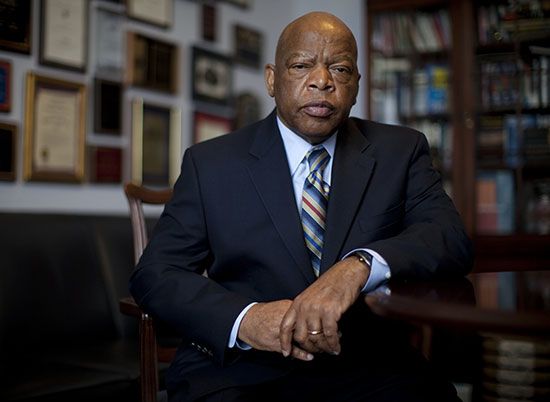
John Lewis: A Legacy Forged in Courage, Dedicated to Civil Rights, and Defined by Service
In the annals of American history, few figures shine as brightly as John Lewis. A true American hero, his life was an epic testament to the power of courage, the unwavering pursuit of justice, and an enduring commitment to service. Born into the stark realities of the segregated South, Lewis transcended his humble beginnings to become a titan of the Civil Rights Movement and a revered member of the U.S. House of Representatives. For over six decades, he was a relentless freedom fighter, dedicating his life to protecting human rights, securing civil liberties, and tirelessly working to build what he eloquently called the "beloved community" in America. His journey, marked by both profound sacrifice and remarkable triumph, continues to inspire generations, reminding us all that when we "see something and do something," we truly can change the world for the better.
From Alabama Fields to the Front Lines of Justice: John Lewis's Early Call to Action
John Lewis’s story began on February 21, 1940, in rural Troy, Alabama, where he was born to sharecropper parents. His childhood was steeped in the challenging environment of the Jim Crow South, a world where racial segregation and injustice were systemic. Yet, even in this oppressive landscape, a spark was ignited within young John. It was through the simple medium of a radio broadcast that he first heard the transformative words of the Rev. Martin Luther King Jr. during the Montgomery Bus Boycott. King's message of nonviolent resistance and the dream of equality resonated deeply with Lewis, compelling him to join the burgeoning movement.
This early inspiration quickly translated into direct action. By 1960, Lewis was a pivotal participant in the first mass lunch counter sit-ins in Nashville, Tennessee, challenging segregation at its most visible points. His commitment to nonviolence, even in the face of aggression, was evident from the outset. This resolve was tested severely during the Freedom Rides in 1961, when he and other activists bravely challenged segregation on interstate buses. In Montgomery, Alabama, Lewis was brutally beaten by a white mob, an attack that left him with lasting scars but only deepened his determination. These early experiences forged the resilient spirit of the young activist, teaching him that "good trouble" was often necessary to confront deeply entrenched injustice.
A Voice for Change: Leading the Movement and Shaping Legislation
John Lewis's prominence in the Civil Rights Movement grew rapidly. In 1963, at the remarkably young age of 23, he stood as a keynote speaker at the historic March on Washington for Jobs and Freedom. His powerful address, advocating for immediate and fundamental change, solidified his position as a leading voice for a generation demanding equality. That same year, he assumed the chairmanship of the Student Nonviolent Coordinating Committee (SNCC), a pivotal organization at the forefront of the movement.
Under Lewis's leadership, SNCC organized critical voter registration efforts and community action programs, most notably during the Mississippi Freedom Summer of 1964. This daring initiative brought hundreds of volunteers, both Black and white, to Mississippi to register African American voters, facing immense resistance and violence from local authorities and white supremacist groups. Lewis's strategic vision and unwavering courage were instrumental in these dangerous but essential campaigns.
The following year, on March 7, 1965, Lewis cemented his place in history during the Selma to Montgomery marches. Alongside Hosea Williams, another stalwart leader, Lewis led over 600 peaceful protestors across the Edmund Pettus Bridge in Selma, Alabama. Their destination was the state capital, Montgomery, to advocate for voting rights. However, their march was violently intercepted by Alabama state troopers and local law enforcement, who attacked the unarmed demonstrators with clubs and tear gas. This brutal confrontation, broadcast to a shocked nation, became known as "Bloody Sunday." The indelible images of Lewis, sustaining a fractured skull from the attack, brought the stark injustice and brutality of the segregated South into American homes and galvanized public and political support for the passage of the landmark Voting Rights Act of 1965. Despite facing further attacks, injuries, and more than 40 arrests throughout his activist career, Lewis never wavered from his philosophy of nonviolence, embodying its true power.
From Activist to Statesman: A Legacy of Legislative Service
After his impactful tenure with SNCC concluded in 1966, John Lewis continued his dedicated work for civil rights and social change. He served as associate director of the Field Foundation, an organization committed to supporting progressive causes. Later, he joined the Southern Regional Council, furthering voter registration programs and promoting racial equality across the South. These roles were crucial in transitioning his on-the-ground activism into broader institutional advocacy.
In 1986, Lewis embarked on a new chapter of service, winning election to the U.S. House of Representatives to represent Georgia’s 5th Congressional District. He would serve in Congress for 33 years until his passing in 2020. In Washington, D.C., he brought the same moral clarity and fierce dedication to justice that had defined his activist years. He rose to become a senior chief deputy whip for the Democratic Party, a key leadership position in the House. He also served on the influential House Ways & Means Committee and chaired its Oversight Subcommittee, where he championed legislation aimed at improving healthcare, education, and economic opportunity for all Americans. Lewis consistently used his legislative platform to advocate for human rights, civil liberties, and ethical governance, always reminding his colleagues of the historical struggles that paved the way for their present responsibilities.
His lifetime of sacrifice and service did not go unnoticed. Lewis received numerous accolades from national and international institutions. In 2015, President Barack Obama bestowed upon him the highest civilian honor, the Presidential Medal of Freedom, recognizing his monumental contributions to American society. This award was a fitting tribute to a man who, despite enduring so much violence, continued to preach love, peace, and the transformative power of nonviolent action.
The Enduring Echo of a "Good Trouble" Maker
John Lewis passed away on July 17, 2020, after a six-month battle with pancreatic cancer, leaving behind an indelible mark on the nation and the world. Yet, his voice and his philosophy continue to resonate powerfully. Lewis often urged people to get into "good trouble, necessary trouble," a phrase that encapsulates his belief in challenging injustice through ethical, nonviolent means. This wasn't a call for chaos, but a moral imperative to disrupt systems of oppression and complacency.
His vision of the "beloved community" was not merely an idealistic dream but a practical blueprint for a society founded on justice, equality, and compassion. It’s a community where racial prejudice and economic disparity are eradicated, and where every individual is treated with dignity and respect. To achieve this, Lewis championed active civic engagement, urging everyone to vote, organize, and speak truth to power.
- Practical Tip: Embrace "Good Trouble": Follow Lewis's example by identifying injustices in your community or society and taking informed, nonviolent action. This could mean advocating for change, participating in peaceful protests, or supporting organizations working for justice.
- Fact: The Power of the Ballot: Lewis consistently emphasized that the right to vote was "the most powerful nonviolent tool we have." His life’s work underscores the importance of voter registration and participation as fundamental to a healthy democracy.
- Actionable Advice: Build the Beloved Community: Engage in dialogue with those different from you, volunteer in initiatives that promote social cohesion, and challenge biases within yourself and your immediate circles. Building a more inclusive society starts with individual actions.
John Lewis’s life was a masterclass in courage, a testament to the idea that ordinary people can achieve extraordinary change. From the brutal beatings on the Freedom Rides to the legislative battles in Congress, he never lost sight of his ultimate goal: a more just and equitable America. We are profoundly indebted to Congressman Lewis, whose unwavering fight for racial equality and encouragement to "keep the faith" truly helped spread the message that "what happens to one of us, happens to all of us." His legacy serves as a perpetual reminder that the fight for human rights and civil liberties is an ongoing journey, one that requires continuous engagement, unwavering hope, and a willingness to make "good trouble" when necessary.